It seems to be a continuous theme: Where did October go? To add to that, I still need to clean out my garden, plant garlic and mulch my strawberries! All these fall activities seem to be crying out to me, "Do it!" Due to a myriad of reasons and excuses, I still have much yard work to do!
In my education as an extension master gardener and gathering of information over the years, I know that these (and other) things need to be done. The garden should be cleaned out to remove any potential diseases. My tomatoes were relatively healthy this year, so I'm not really worried about diseases. However, the garden looks better if I clean it out. If I had disease in my garden this year, it would be important to remove dead plants and fruit and dispose of it at the brush dump or by burning.
And the removal of leftover fruit is important, too. Tomato seeds will germinate after chilling in the garden all winter. Hybrids will probably revert to a parent plant or other ancestor. Open-pollinated tomato seeds will come back as they were the year before. Volunteer tomatoes are fun and I have heard of people keeping a "wild" tomato patch that grows every year from seed. While this is tempting, the truth is that we (including me) should rotate crops in our gardens. It is rather difficult to do minimum three-year rotation when I love tomatoes so much!
Now, there is the planting of the garlic. I don't think I've ever been on time with planting my garlic or other fall bulbs. These should be planted toward early or mid-October so that they have time to grow some roots before freezing. Ideally. If there is a break in the weather, I will plant garlic as long as the ground is not frozen. That way, in the spring, it can start growing as soon as conditions warrant. Getting it in the ground now is better than waiting until spring.
And finally, it's important to mulch my strawberries and the garlic that I WILL get planted. These things may do okay if temperatures are mild or we have a good amount of snow cover. Since we cannot predict the winter, our insurance in this case is mulch. Just about anything can be used for mulch. I am still hoping for one more cutting of grass to use as mulch or general cover for my bare garden. Cut grass will develop layers and a harder cover. This is not always so good, but I've made it work by being careful when I remove it. If it's left on too long, the plants will die soon after they start their spring growth. Leaves are a good mulch, as long as they do not blow away. I am hoping to find some good, cheap straw this fall. Unfortunately, I've heard that straw and other bedding might be expensive this year.
Happy Gardening and I hope you're ahead of me!
Wednesday, November 6, 2013

Monday, November 26, 2012
Tool Cleanup
In the course of bringing the growing season to a close, it's important to take a look at our tools. I was reminded of this through the Florida Master Gardener Program Facebook page. They had a post recently about cleaning and performing maintenance on garden tools. And this makes a lot of sense.
At the close of the season, it is a good idea to clean the tools. Just as I have a hard time getting to my blog during the growing season, I tend to put off maintenance on tools. As long as I can manage with them as they are, then it's good...right? Okay, when I say, "...right?" like that, the answer usually is, "no." While this is a good time to work on tools if necessary, we really should be cleaning them as we go.
I'm guilty! And I know better. It's common knowledge that some diseases can be transmitted fairly easily through dirty tools. The 'mum research I did just a week or so ago suggested as much. Houseplant tools are an easy carrier of the nasties, too. But it's so EASY to trim, prune and dig without cleaning tools in between. Sometimes we can transmit the diseases without even knowing, as well.
So, in the course of cleaning any dirt from our garden tools, we also want to think about cleaning pruners from the garden and house, as well.
For the end-of-season cleaning of garden tools, use a wire brush for any dried-on soil. Use WD-40 a little extra cleaning and conditioning of the tool. I have a friend who uses a five-gallon bucket filled with sand that has been mixed with a little motor oil. She aspires to clean her tools after every use with this set-up. By having a system set up, she can achieve this goal a bit more easily than those of us who are not ready. And if successful, she would not need to go through this annual catch-up.
Now, in order to prevent transmission of disease on tools, the general rule is to use a 10 percent bleach solution. This concentration is also good for disinfecting used pots prior to using. To achieve this solution, mix one part bleach per nine parts water. Use a larger bucket for disinfecting larger tools and pots and decrease the amount mixed for smaller uses. Contact by this solution on the tools should last for at least 15 seconds.
By cleaning and disinfecting tools, we can benefit by keeping the tools in good shape, as well as our plants, gardens and yards by preventing the spread of infection.
At the close of the season, it is a good idea to clean the tools. Just as I have a hard time getting to my blog during the growing season, I tend to put off maintenance on tools. As long as I can manage with them as they are, then it's good...right? Okay, when I say, "...right?" like that, the answer usually is, "no." While this is a good time to work on tools if necessary, we really should be cleaning them as we go.
I'm guilty! And I know better. It's common knowledge that some diseases can be transmitted fairly easily through dirty tools. The 'mum research I did just a week or so ago suggested as much. Houseplant tools are an easy carrier of the nasties, too. But it's so EASY to trim, prune and dig without cleaning tools in between. Sometimes we can transmit the diseases without even knowing, as well.
So, in the course of cleaning any dirt from our garden tools, we also want to think about cleaning pruners from the garden and house, as well.
For the end-of-season cleaning of garden tools, use a wire brush for any dried-on soil. Use WD-40 a little extra cleaning and conditioning of the tool. I have a friend who uses a five-gallon bucket filled with sand that has been mixed with a little motor oil. She aspires to clean her tools after every use with this set-up. By having a system set up, she can achieve this goal a bit more easily than those of us who are not ready. And if successful, she would not need to go through this annual catch-up.
Now, in order to prevent transmission of disease on tools, the general rule is to use a 10 percent bleach solution. This concentration is also good for disinfecting used pots prior to using. To achieve this solution, mix one part bleach per nine parts water. Use a larger bucket for disinfecting larger tools and pots and decrease the amount mixed for smaller uses. Contact by this solution on the tools should last for at least 15 seconds.
By cleaning and disinfecting tools, we can benefit by keeping the tools in good shape, as well as our plants, gardens and yards by preventing the spread of infection.
Friday, November 16, 2012
To Blog or To Garden
I wonder how many blogs start with, "It's been a long time since my last entry..." Okay, well it has. I've struggled all year with time. But I still managed to garden and have a relatively good harvest, despite some weather issues. And now, it's time to put it all to bed.
Since our freeze and the death of my summer's labors, the garden space is black with decay. It is tempting, in this trend of busy schedules, to simply leave the garden remains to decay in the garden. After all, it would simply make good compost, right? Or would it?
By leaving old garden remains where they fall, we could also be leaving a host of issues that will continue for another season or longer. First off, any plant matter that is left on the garden may be host to diseases that will winter over and return in the following growing season. For many plants, whether vegetables or flowers, it's best to remove plant debris from the bed. This is good practice during the growing season, as well as at the year-end clean-up.
Second, any fruit left on the garden may germinate the next year. If you're like me, however, when a stray tomato plant comes up, it's fun to let it grow and see which heirloom variety it is or what the hybrid seed will come back as. I hate killing plants! But now, I have a large section of my garden that grew tomatoes this past season and may also have more volunteers in the spring. This will reduce my options when it comes to rotating my garden crops (another good way to reduce garden diseases.)
And lastly, the aesthetic reason for cleaning up the garden: it simply looks better! When I look at my clean garden area, I am pleased with the conclusion of the garden season. If I were still looking at the carcasses of my beloved tomato plants, I might just become a little teary!
So, for these reasons, I advise all gardeners to clean up gardens by removing all plant and fruit debris. This clean-up may seem like a lot of work, but I find that it's the considerations and thinking that end up taking more time!
Happy Fall!
Since our freeze and the death of my summer's labors, the garden space is black with decay. It is tempting, in this trend of busy schedules, to simply leave the garden remains to decay in the garden. After all, it would simply make good compost, right? Or would it?
By leaving old garden remains where they fall, we could also be leaving a host of issues that will continue for another season or longer. First off, any plant matter that is left on the garden may be host to diseases that will winter over and return in the following growing season. For many plants, whether vegetables or flowers, it's best to remove plant debris from the bed. This is good practice during the growing season, as well as at the year-end clean-up.
Second, any fruit left on the garden may germinate the next year. If you're like me, however, when a stray tomato plant comes up, it's fun to let it grow and see which heirloom variety it is or what the hybrid seed will come back as. I hate killing plants! But now, I have a large section of my garden that grew tomatoes this past season and may also have more volunteers in the spring. This will reduce my options when it comes to rotating my garden crops (another good way to reduce garden diseases.)
And lastly, the aesthetic reason for cleaning up the garden: it simply looks better! When I look at my clean garden area, I am pleased with the conclusion of the garden season. If I were still looking at the carcasses of my beloved tomato plants, I might just become a little teary!
So, for these reasons, I advise all gardeners to clean up gardens by removing all plant and fruit debris. This clean-up may seem like a lot of work, but I find that it's the considerations and thinking that end up taking more time!
Happy Fall!
Thursday, March 15, 2012
What To Do...
As this weather continues to defy the averages, it's difficult to understand what to do about the garden! I went on last fall about mulching, especially as the temperatures dropped and we had no insulating snow cover. And now, every time I walk by my garlic and strawberry beds, I wonder if I should uncover them. I always told myself it was too early. "What happens when we get that late-season snow or the temps drop back to zero" I would ask myself.
However, I've learned from other master gardeners that with these warm temps, the strawberry plants can mildew. I also know that garlic in Iowa is growing. Mine can't be too far behind, can it?
With that said, I'd better go take a peek and see what's going on
However, I've learned from other master gardeners that with these warm temps, the strawberry plants can mildew. I also know that garlic in Iowa is growing. Mine can't be too far behind, can it?
With that said, I'd better go take a peek and see what's going on
Friday, January 27, 2012
New USDA Hardiness Zones and Interactive Map
Yesterday, the USDA released a revised "Plant Hardiness Zone Map." It is GIS based and considered more accurate because of increased reliability of data and a longer time frame of data used. Other factors were also considered in determining the appropriate zone layout.
Here is a link to the interactive map. You can enter your zip code and get a quick return on your zone. Although I was hoping for a warmer zone 5 (only so I could plant a Granny Smith applie tree), my zip now shows as zone 4b.
http://planthardiness.ars.usda.gov/PHZMWeb/
Enjoy!
Here is a link to the interactive map. You can enter your zip code and get a quick return on your zone. Although I was hoping for a warmer zone 5 (only so I could plant a Granny Smith applie tree), my zip now shows as zone 4b.
http://planthardiness.ars.usda.gov/PHZMWeb/
Enjoy!
Tuesday, January 3, 2012
Butterfly Garden?
As I was planning to plan my 2012 garden, I was really only thinking of vegetables. But I came across this post on the University of Minnesota Extension website regarding butterfly gardening.
http://www.extension.umn.edu/distribution/horticulture/components/DG6711e.html
And non-vegetable gardens deserve as much planning as vegetable gardens. Although I feel that by producing vegetables, I am providing for my family. However, there is an aesthetic property to having a beautiful yard that will provide season-long enjoyment for me and my family. I bet the neighbors will be thankful for a nice plot of flowers, too.
My past leanings have been for perennials. I think that was mostly driven my my frugal nature. But in the Extension's publication, I learned that butterflies mostly want nectar and that since annuals tend to bloom for long stretches of the summer, they can provide well for them. There is also a need for perennials, as they can provide variation over many seasons. Additionally, a divers planting can provide a flower bed that is more resistant to any single environmental problem.
As I continue on my planning journey, I will be considering placement of a butterfly garden.
http://www.extension.umn.edu/distribution/horticulture/components/DG6711e.html
And non-vegetable gardens deserve as much planning as vegetable gardens. Although I feel that by producing vegetables, I am providing for my family. However, there is an aesthetic property to having a beautiful yard that will provide season-long enjoyment for me and my family. I bet the neighbors will be thankful for a nice plot of flowers, too.
My past leanings have been for perennials. I think that was mostly driven my my frugal nature. But in the Extension's publication, I learned that butterflies mostly want nectar and that since annuals tend to bloom for long stretches of the summer, they can provide well for them. There is also a need for perennials, as they can provide variation over many seasons. Additionally, a divers planting can provide a flower bed that is more resistant to any single environmental problem.
As I continue on my planning journey, I will be considering placement of a butterfly garden.
Sunday, January 1, 2012
Planning to Plan
Okay, so it's only January 1st. But based on my past procrastination, I think it's not too early to get planning for the upcoming growing season. Yes, it is upcoming and time to plant seeds indoors will be here before I know it!
So, before I plant seeds, I need to reflect on past growing seasons - what worked and did not work - as well as what I want to try. Without this reflection and planning, my gardening probably will revert back to the haphazard nature of times past. I'd like to avoid as much of that as possible! Also, by planning, I feel better equipped to purchase seeds and plants. If I can start seeds for something I want in my garden, I can be sure of getting the variety I want, while hopefully saving a few pennies.
Since my planning is a process, I will be posting more information as I go through it! For now, I will be perusing the seed catalogs I have already received in the mail!
Happy gardening, already!
So, before I plant seeds, I need to reflect on past growing seasons - what worked and did not work - as well as what I want to try. Without this reflection and planning, my gardening probably will revert back to the haphazard nature of times past. I'd like to avoid as much of that as possible! Also, by planning, I feel better equipped to purchase seeds and plants. If I can start seeds for something I want in my garden, I can be sure of getting the variety I want, while hopefully saving a few pennies.
Since my planning is a process, I will be posting more information as I go through it! For now, I will be perusing the seed catalogs I have already received in the mail!
Happy gardening, already!
Thursday, December 15, 2011
Poinsettias
Here is a quick post regarding poinsettias. Take a look at this University of Illinois Extension site - it's loaded with information on poinsettias!
http://urbanext.illinois.edu/poinsettia/index.cfm
Take this new knowledge and enjoy the season!!
http://urbanext.illinois.edu/poinsettia/index.cfm
Take this new knowledge and enjoy the season!!
Wednesday, May 18, 2011
Rhubarb, Raspberries and Edible Landscaping
Spring is such a great time of year. To me, it's miraculous how things revive after the long, dormant winter. The first flowers sprout, hostas return, asparagus comes up, and my favorite - rhubarb - comes back to life!
As I find out more about "edible landscaping," I realize that I have been thinking about this long before I was aware it was a new method of landscape design I've thought a lot in recent year about making my garden and yard spaces more about plants that produce food, than for mere aesthetically pleasing plants. And I've always coveted my neighbors rhubarb for both it's beauty and tastiness! (Please forgive me!)
I'm starting my fourth growing season in my current location and I am slowly learning how things grow in my yard. With this knowledge, I am able to plan and move things around as I attempt to make it all customized to my and my family's wants and needs.
When I came home with my girls after 5:00 yesterday afternoon, I went inside to start dinner and my girls went out to play. Before long, they came back inside and excitedly told me that some plants were missing. I did not know what they were talking about, so they took me outside to show me. To my joy, a friend had apparently come during the day and removed three of my red-twig dogwood bushes for her daughter. (Or there really was a bush thief!) This has freed up space for either rhubarb or raspberries in these high-sun locations.
Luckily, I have both fairly readily available as transplants from friends or to move from other spaces in my garden. A friend of mine has given me harvested rhubarb for the past three or four seasons. I always appreciate that! And now I have space that is open and ready for a transplant.
But I also have one or two pots of yellow raspberries that need to be put into the ground. They have wintered over twice in the pots. I am unsure of if it is two pots, because they have evidently made runners and are creating their own patch, despite being in a fairly shady area. According to a publication by the University of Minnesota Extension (http://www.extension.umn.edu/distribution/horticulture/DG1108.html), red and yellow raspberries are the only ones that spread and create a patch. Black and most purple raspberries, by nature of the way they grow, do not spread as readily.. Raspberries should be planted in a full-sun, well-drained area that has good air circulation. This makes my newly-available spot seem ideal. This spot is at the top of a retention wall in full sun. It will have air circulation on all sides, as well as be in sun for most of the day.
So, what about rhubarb in this spot? I will have other spaces open, at least eventually. But I could plant rhubarb here and then plant the raspberries closer to others that I have. But from what I have read, it might be better to separate the patches of raspberries, to promote diversity and keep diseased plants, if it develops, from taking out all my raspberries.
But to be ready for my eventual rhubarb planting, I want to understand the best place for it. Where ever it is planted, it will be pretty! But I want to give it the best possible chance to thrive. I had a couple of questions this spring about rhubarb bolting already. Usually, the bloom stalks develop a little later in the season. Also, I have had a question on fertilization of rhubarb. All of this has lead me to ask a few more-knowledgeable people about rhubarb, as well as consult the Extension's flyer on rhubarb. This flyer can be found at http://www.extension.umn.edu/distribution/horticulture/M1260.html. (Interestingly, this flyer addresses growing sorrel, as well. This is yet another plant I can add to my edible landscaping plan!)
In this flyer, it states that rhubarb should be grown in full sun in a well-drained location. So, it has similar needs as raspberries. Additionally, rhubarb can benefit from incorporating commercial fertilizer or compost into the soil before planting. Additional fertilization should happen annually in the spring.
Now, I just need to figure out how much rhubarb to plant!
As I find out more about "edible landscaping," I realize that I have been thinking about this long before I was aware it was a new method of landscape design I've thought a lot in recent year about making my garden and yard spaces more about plants that produce food, than for mere aesthetically pleasing plants. And I've always coveted my neighbors rhubarb for both it's beauty and tastiness! (Please forgive me!)
I'm starting my fourth growing season in my current location and I am slowly learning how things grow in my yard. With this knowledge, I am able to plan and move things around as I attempt to make it all customized to my and my family's wants and needs.
When I came home with my girls after 5:00 yesterday afternoon, I went inside to start dinner and my girls went out to play. Before long, they came back inside and excitedly told me that some plants were missing. I did not know what they were talking about, so they took me outside to show me. To my joy, a friend had apparently come during the day and removed three of my red-twig dogwood bushes for her daughter. (Or there really was a bush thief!) This has freed up space for either rhubarb or raspberries in these high-sun locations.
Luckily, I have both fairly readily available as transplants from friends or to move from other spaces in my garden. A friend of mine has given me harvested rhubarb for the past three or four seasons. I always appreciate that! And now I have space that is open and ready for a transplant.
But I also have one or two pots of yellow raspberries that need to be put into the ground. They have wintered over twice in the pots. I am unsure of if it is two pots, because they have evidently made runners and are creating their own patch, despite being in a fairly shady area. According to a publication by the University of Minnesota Extension (http://www.extension.umn.edu/distribution/horticulture/DG1108.html), red and yellow raspberries are the only ones that spread and create a patch. Black and most purple raspberries, by nature of the way they grow, do not spread as readily.. Raspberries should be planted in a full-sun, well-drained area that has good air circulation. This makes my newly-available spot seem ideal. This spot is at the top of a retention wall in full sun. It will have air circulation on all sides, as well as be in sun for most of the day.
So, what about rhubarb in this spot? I will have other spaces open, at least eventually. But I could plant rhubarb here and then plant the raspberries closer to others that I have. But from what I have read, it might be better to separate the patches of raspberries, to promote diversity and keep diseased plants, if it develops, from taking out all my raspberries.
But to be ready for my eventual rhubarb planting, I want to understand the best place for it. Where ever it is planted, it will be pretty! But I want to give it the best possible chance to thrive. I had a couple of questions this spring about rhubarb bolting already. Usually, the bloom stalks develop a little later in the season. Also, I have had a question on fertilization of rhubarb. All of this has lead me to ask a few more-knowledgeable people about rhubarb, as well as consult the Extension's flyer on rhubarb. This flyer can be found at http://www.extension.umn.edu/distribution/horticulture/M1260.html. (Interestingly, this flyer addresses growing sorrel, as well. This is yet another plant I can add to my edible landscaping plan!)
In this flyer, it states that rhubarb should be grown in full sun in a well-drained location. So, it has similar needs as raspberries. Additionally, rhubarb can benefit from incorporating commercial fertilizer or compost into the soil before planting. Additional fertilization should happen annually in the spring.
Now, I just need to figure out how much rhubarb to plant!
Wednesday, April 20, 2011
Compost Junkie
I have to come to grips with this - I just love composting. It's amazing to me how it adds up. My gallon bucket fills up within two days. And during the winter, when the compost bin in the yard only piles up and doesn't decompose, it builds into a mountain!
Anymore, I have a hard time throwing anything away that can be composted. When I was at work today, I put a banana peel in my laptop bag to bring home for the bin. It also makes me wonder where all the compostable trash from the cafeteria goes.
When I was in grade school, we had a gym teacher who was also a farmer. The cafeteria ladies saved him all the food waste for his hogs. I wonder if there is any sorting of the trash here...
There are many benefits to composting. Obviously, there is a reduction in waste going to the landfill. The result of composting is a rich soil that provides natural nutrition when added to flower and vegetable beds. The EPA has a good list of benefits at http://www.epa.gov/osw/conserve/rrr/composting/benefits.htm.
Also, the University of Minnesota has a good article about basic composting at http://www.extension.umn.edu/distribution/horticulture/DG3899.html.
Back to my issue - I need to remember to take the banana peel from my bag before it decomposes there.
Anymore, I have a hard time throwing anything away that can be composted. When I was at work today, I put a banana peel in my laptop bag to bring home for the bin. It also makes me wonder where all the compostable trash from the cafeteria goes.
When I was in grade school, we had a gym teacher who was also a farmer. The cafeteria ladies saved him all the food waste for his hogs. I wonder if there is any sorting of the trash here...
There are many benefits to composting. Obviously, there is a reduction in waste going to the landfill. The result of composting is a rich soil that provides natural nutrition when added to flower and vegetable beds. The EPA has a good list of benefits at http://www.epa.gov/osw/conserve/rrr/composting/benefits.htm.
Also, the University of Minnesota has a good article about basic composting at http://www.extension.umn.edu/distribution/horticulture/DG3899.html.
Back to my issue - I need to remember to take the banana peel from my bag before it decomposes there.
Monday, March 21, 2011
Receding Snow
I have been recently considering how the snow cover affects our lawn, perennials and gardens. Sometimes the tough winters for us are those that are cold and have lots of snow. But do the greater depths of snow really equate to a "hard" winter?
In my core course for Master Gardening last year, I read some factual information as to what I had already observed. A deep cover of snow acts as a significant insulation for the ground and plants. I am in the process of looking for a factual representation of this. Common thought on this is that ten inches of new "fluffy" snow equals roughly six inches of fiberglass insulation. A food of snow can allow the ground to retain 32-degree temperatures.
No wonder my strawberry plants look good!
In my observations, I have seen how green the grass is when it emerges from the snow cover. But where we make paths through the yard, and therefore the insulation is less, the grass is less green.

The above is a picture of our backyard, showing the footpath we keep clear for walking to the bus, skating, and church. You can clearly see the brown that was the main path. For most of the winter, it was covered with a couple of inches of packed snow and ice.
Spring has sprung! Now, if it would just hurry up to planting time!
In my core course for Master Gardening last year, I read some factual information as to what I had already observed. A deep cover of snow acts as a significant insulation for the ground and plants. I am in the process of looking for a factual representation of this. Common thought on this is that ten inches of new "fluffy" snow equals roughly six inches of fiberglass insulation. A food of snow can allow the ground to retain 32-degree temperatures.
No wonder my strawberry plants look good!
In my observations, I have seen how green the grass is when it emerges from the snow cover. But where we make paths through the yard, and therefore the insulation is less, the grass is less green.

Spring has sprung! Now, if it would just hurry up to planting time!
Thursday, March 10, 2011
Seeds!
It must be late winter! I have been going through seed catalogues and really looking forward to the spring thaw. I also had information for the U's seed trials program and was going to sign up for that. But as luck would have it, I got distracted by some other things and missed the deadline! So, I will be starting only my own seeds and will be able to share with anyone in the area - I'm sure I'll have some extras.
Cantaloupe (Sweet N Early)
Watermelons (Georgia Rattlesnake and Carolina Cross 193)
Gourd (Orn Luffa)
Tomatoes (Brandywine, Super sweet 100 hybrid, Cherokee Purple, Tye Dye hybrid, Black Krim heirloom)
Pumpkin (Rouge VIF D'Etampes)
Squash (SuperZuke hybrid)
Cabbage (Salad Delight)
Celery (Tall Utah 52)
Eggplant (long purple)
Lettuce (Iceburg A for Joe)
Pepper (Sweet Maxibelle)
My order from Johnny Seeds will probably be mostly herbs, as I am considering moving and expanding my herb garden.

Tuesday, January 4, 2011
Poinsettia Care
As I read about how to take care of my post-holiday poinsettia, I see that I am doing some things wrong! That's no surprise, though. I have been working to get the watering right - not too dry or too wet and not sitting in water. However, the environmental temperature seems to be not so good in my house. According to a Yard & Garden Brief produced by the University of Minnesota Extension (http://www.extension.umn.edu/projects/yardandgarden/ygbriefs/h102poinsettia.html), poinsettias should get at least six hours of bright sunny natural daylight and stay between 65 and 70 degrees. I can get the sunlight for the plant, however we keep our house primarily at 65 degrees during the day, but let the indoor temperature fall at night. In order to resolve this problem, I may need to move the plant between day and night locations. I may need to put it on an inside wall near my aquariums at night - this may be the place where the temperature drops the least at night. And during the day, it should be close to the windows in the southeast room in my house.
For additional optimal care of poinsettias, the Yard & Garden Brief recommends fertilizing the plant 6-8 weeks after acquiring it. This will help maintain the nice foliage and allow for new growth. As with all potted plants, follow the directions on the label of the houseplant fertilizer but mix to half-strength. This will help prevent over fertilization - the symptoms of which cannot be reversed. According to the Yard & Garden Brief referenced above, repeat again in another 6-8 weeks.
By the time summer rolls around, you can re-pot and prune the plant back, allowing for further growth. And for those who are most ambitious, check back to the Yard & Garden Brief to understand the process for making it bloom again for the next holiday season!
For now, I will use this information to try to keep my poinsettia nice for as long as possible. I wish you luck in doing the same!
By the way, while I lived in northeast Florida, we would often take holiday poinsettias and plant them in the ground. They made a very interesting bush that would easily grow to five feet tall. Every few years, a killing frost would cut it back to the ground, but it would survive and grow again.
For additional optimal care of poinsettias, the Yard & Garden Brief recommends fertilizing the plant 6-8 weeks after acquiring it. This will help maintain the nice foliage and allow for new growth. As with all potted plants, follow the directions on the label of the houseplant fertilizer but mix to half-strength. This will help prevent over fertilization - the symptoms of which cannot be reversed. According to the Yard & Garden Brief referenced above, repeat again in another 6-8 weeks.
By the time summer rolls around, you can re-pot and prune the plant back, allowing for further growth. And for those who are most ambitious, check back to the Yard & Garden Brief to understand the process for making it bloom again for the next holiday season!
For now, I will use this information to try to keep my poinsettia nice for as long as possible. I wish you luck in doing the same!
By the way, while I lived in northeast Florida, we would often take holiday poinsettias and plant them in the ground. They made a very interesting bush that would easily grow to five feet tall. Every few years, a killing frost would cut it back to the ground, but it would survive and grow again.
Sunday, January 2, 2011
Holiday And Houseplant Care
Happy New Year! Now that the holidays are winding up, what do we do with these holiday plants? We might have poinsettias, amaryllis, holiday cacti, and the likes sitting around the house. And with these, I really don't want to throw them out - I'd almost rather slowly kill them in my dry, winter indoor climate, than just throw them out! But, in trying to be a better plant-owner, I thought it would be good to review some basics on houseplant care and specific care for these plants.
Basically, houseplants need adequate light, water, and food in the proper amount and quality. Too little or too much of any of these things can cause stress on houseplants. Other factors include humidity, ventilation, and temperature.
Light is usually a challenge with indoor plants. Most plants struggle to get enough light indoors. My best spot for sun in my house is a room situated on the southeast corner of my house. It is the brightest room for the longest time of the day. For these most common holiday plants, they will need as much quality light as possible. Regarding other common houseplants, it is almost impossible for a plant to get too much light inside a home or other building.
Watering is another essential in caring for indoor plants. According to the University of Minnesota Extension, houseplants are most commonly over watered. And this is the opposite of my problem - under watering. Some houseplants do better slightly with slightly drier conditions, where others do better with a little more water. The best advice I can give is to regularly check on all houseplants. As a general rule, if you push your finger into the soil by about one to one-and-a-half inches and you don't feel moisture, it's time to water. If you do feel some moisture, let the plant go another day and check it again. In our northern heated houses, it is very important to keep in mind that the indoor humidity is very low. Therefore, plants will dry out quickly.
I had a visitor on New Year's Eve who noted that my plants were very dry. I hadn't checked on them for two days and they seemed like they hadn't been watered for weeks! (Please note here that I am a recovering plant torturer and killer. I am really trying to do better, but need to change old habits!)
One problem with over watering, is that if a plant's roots stay wet all the time, most plants will develop root rot. This will lead to certain death of the plant. Poinsettias are especially prone to this problem. If left in the common decorative foil pot covering, make sure to remove it for watering purposes. Saturate the soil and allow it to totally drain out before returning the plant to the foil. This practice is a good rule of thumb for all houseplants. Water thoroughly and allow to drain out. If pots are set in saucers, empty the saucers after 10 or 15 minutes or the soil may draw the water back up, thus over saturating the plant.
This also brings us to a side topic of soil. It's important to have proper exposure to air, nutrients, and water. Also, the soil should drain well, but also retain some water for use by the plant. It's easiest for me to simply find a good potting soil at a garden center. Those more discerning can put together a custom blend of garden loam, organic matter, and sand. The North Dakota State University Extension Service has a great publication on houseplants, including details about building and pasteurizing your own potting soil. The web address is: http://www.ag.ndsu.edu/pubs/plantsci/landscap/pp744.pdf.
And finally, it's good to give your houseplants some food once in a while, too. Plants do make their own food through the process of photosynthesis. Supplemental food can be given through use of a fertilizer. Fertilize only during the time when the plant is actively growing and not under stress. When using a commercial fertilizer, read all the label instructions, then mix the fertilizer to half-strength and feed. This information is recommended by the University of Minnesota Extension to help avoid overfeeding a plant. Symptoms of over-fertilization are not reversible.
Use these general guidelines for caring for those holiday plants and all houseplants. As time goes, I hope to post more about specific plants and customized care for them! Good luck and enjoy the new year!
Basically, houseplants need adequate light, water, and food in the proper amount and quality. Too little or too much of any of these things can cause stress on houseplants. Other factors include humidity, ventilation, and temperature.
Light is usually a challenge with indoor plants. Most plants struggle to get enough light indoors. My best spot for sun in my house is a room situated on the southeast corner of my house. It is the brightest room for the longest time of the day. For these most common holiday plants, they will need as much quality light as possible. Regarding other common houseplants, it is almost impossible for a plant to get too much light inside a home or other building.
Watering is another essential in caring for indoor plants. According to the University of Minnesota Extension, houseplants are most commonly over watered. And this is the opposite of my problem - under watering. Some houseplants do better slightly with slightly drier conditions, where others do better with a little more water. The best advice I can give is to regularly check on all houseplants. As a general rule, if you push your finger into the soil by about one to one-and-a-half inches and you don't feel moisture, it's time to water. If you do feel some moisture, let the plant go another day and check it again. In our northern heated houses, it is very important to keep in mind that the indoor humidity is very low. Therefore, plants will dry out quickly.
I had a visitor on New Year's Eve who noted that my plants were very dry. I hadn't checked on them for two days and they seemed like they hadn't been watered for weeks! (Please note here that I am a recovering plant torturer and killer. I am really trying to do better, but need to change old habits!)
One problem with over watering, is that if a plant's roots stay wet all the time, most plants will develop root rot. This will lead to certain death of the plant. Poinsettias are especially prone to this problem. If left in the common decorative foil pot covering, make sure to remove it for watering purposes. Saturate the soil and allow it to totally drain out before returning the plant to the foil. This practice is a good rule of thumb for all houseplants. Water thoroughly and allow to drain out. If pots are set in saucers, empty the saucers after 10 or 15 minutes or the soil may draw the water back up, thus over saturating the plant.
This also brings us to a side topic of soil. It's important to have proper exposure to air, nutrients, and water. Also, the soil should drain well, but also retain some water for use by the plant. It's easiest for me to simply find a good potting soil at a garden center. Those more discerning can put together a custom blend of garden loam, organic matter, and sand. The North Dakota State University Extension Service has a great publication on houseplants, including details about building and pasteurizing your own potting soil. The web address is: http://www.ag.ndsu.edu/pubs/plantsci/landscap/pp744.pdf.
And finally, it's good to give your houseplants some food once in a while, too. Plants do make their own food through the process of photosynthesis. Supplemental food can be given through use of a fertilizer. Fertilize only during the time when the plant is actively growing and not under stress. When using a commercial fertilizer, read all the label instructions, then mix the fertilizer to half-strength and feed. This information is recommended by the University of Minnesota Extension to help avoid overfeeding a plant. Symptoms of over-fertilization are not reversible.
Use these general guidelines for caring for those holiday plants and all houseplants. As time goes, I hope to post more about specific plants and customized care for them! Good luck and enjoy the new year!
Friday, December 31, 2010
General Vegetable Favorite and More Space
As part of my garden-planning activity, I find it necessary to consider what I will be growing. This really is first priority - from there, I will be able to figure out what I can do with my space and if I really need additional garden space outside of my property.
Why is it important to consider space? Proper spacing of plants - vegetable, flowers, trees and shrubs included - is important to allow allow air circulation, light penetration and room for growth.
The first consideration is to allow enough room for the plant at maturity. Generally speaking, follow directions that come with the seed or plant. This will help ensure that there is plenty of space for the full-grown plant and fruit. Some seeds allow for planting densely, but thinning after sprouts emerge from the soil. Some of the vining plants take up a lot of space at maturity. I really enjoyed growing my watermelons this past year, but they required more space than I actually allowed for. If I were to plant multiple watermelon hills next year, I believe I would allow for a circle extending five feet outward from each plant. As I recall, the package stated three feet between plants, but it seems that ten feet between plants would have been appropriate. As you may have seen with my watermelon post, the vines were prolific and took over other areas of the garden!
I love veggies and especially from my own garden. And I have my favorites both to grow and to eat. But also there are various new things I will want to try. My favorite eating vegetable is the tomato. I love most varieties and enjoy growing them, as well. But the most fun I have had actually growing a vegetable was this past season when I had watermelons that took over a lot of my garden space. In August, they were increasing in size daily and almost as I watched! To me, zucchini is also fun to grow because they are such prolific producers. Other veggies I might want to grow next year include garlic, herbs, carrots, pumpkins, sweet corn, lettuce, spinach, snow peas, peppers, potatoes, and radishes. Probably I will discover others that I want to try, as well.
From one of my previous posts, I had to figure out what space I would have available for this coming growing season. I have decided to add to my garden space in our yard, thus sacrificing some of the kids' grassy open back yard. I am adding about 300 square feet by turning over a space of about 10 feet by 30 feet. I went to the Gopher State One Call website (http://gopherstateonecall.org/) to submit a plan and they efficiently coordinated marking of all utilities in the area. I may still look for additional garden space, but this will at least allow for some vining crops (only three of those watermelon vines, though!)
So, in planning my garden, I know the importance of space and so far some favorites that I want to grow. Now the detailed planning can begin - I'll browse some seed catalogs and make my specific plan.
Why is it important to consider space? Proper spacing of plants - vegetable, flowers, trees and shrubs included - is important to allow allow air circulation, light penetration and room for growth.
The first consideration is to allow enough room for the plant at maturity. Generally speaking, follow directions that come with the seed or plant. This will help ensure that there is plenty of space for the full-grown plant and fruit. Some seeds allow for planting densely, but thinning after sprouts emerge from the soil. Some of the vining plants take up a lot of space at maturity. I really enjoyed growing my watermelons this past year, but they required more space than I actually allowed for. If I were to plant multiple watermelon hills next year, I believe I would allow for a circle extending five feet outward from each plant. As I recall, the package stated three feet between plants, but it seems that ten feet between plants would have been appropriate. As you may have seen with my watermelon post, the vines were prolific and took over other areas of the garden!
I love veggies and especially from my own garden. And I have my favorites both to grow and to eat. But also there are various new things I will want to try. My favorite eating vegetable is the tomato. I love most varieties and enjoy growing them, as well. But the most fun I have had actually growing a vegetable was this past season when I had watermelons that took over a lot of my garden space. In August, they were increasing in size daily and almost as I watched! To me, zucchini is also fun to grow because they are such prolific producers. Other veggies I might want to grow next year include garlic, herbs, carrots, pumpkins, sweet corn, lettuce, spinach, snow peas, peppers, potatoes, and radishes. Probably I will discover others that I want to try, as well.
From one of my previous posts, I had to figure out what space I would have available for this coming growing season. I have decided to add to my garden space in our yard, thus sacrificing some of the kids' grassy open back yard. I am adding about 300 square feet by turning over a space of about 10 feet by 30 feet. I went to the Gopher State One Call website (http://gopherstateonecall.org/) to submit a plan and they efficiently coordinated marking of all utilities in the area. I may still look for additional garden space, but this will at least allow for some vining crops (only three of those watermelon vines, though!)
So, in planning my garden, I know the importance of space and so far some favorites that I want to grow. Now the detailed planning can begin - I'll browse some seed catalogs and make my specific plan.
Tuesday, November 9, 2010
Houseplants, Procrastination, and Repotting
Okay, I think it's past time to prepare the houseplants for winter. Actually, if I was up on things, I would have started preparing and acclimating my plants many weeks ago. As it is now, when the forecast is for frost, I put plants into the garage or bring them into the house. I was prompted to think more about this after some fellow master gardeners had a conversation about Gerber daisies and wintering them indoors. I have a number of houseplants that I sent outside for the summer and would like to keep them over the winter. Bringing them back inside, however, poses a few potential problems. Previously mentioned is the fact that sometimes plants do better if gradually acclimatized to the indoor conditions or they will go through somewhat of a shock period. This is similar to taking them out in the spring - they have to adjust. Differing from the spring procedure, the fall indoor migration must also consider pests. I think we don't care about taking any extra pests outside in the spring, but most would agree that we don't want to provide winter shelter for these unwanted hitch hikers!
From what I understand, the most prolific pests on houseplants are mites and aphids. The first thing to do in looking for any pests is to visually inspect plants. In our area of southeast Minnesota, we had an early-season problem with earwigs - and they were everywhere! I was barely aware of this insect until this season. Fortunately, as the summer progressed, I noticed fewer of them around. And as I now inspect my potted plants, I have yet to see even one. In looking at my plants, I see some damage that was caused when I allowed some of my plants to dry out too much. Most plants look okay, except for my Christmas cactus. These plants have obvious signs of having been on the dinner buffet of some insect. I hope they left a good tip! Other than outright damage, some pests leave clues to their presence. The clues can include small spider-like webs, honey dew (sticky drops on plant surfaces), and blemishes to the plant foliage. And the scariest (to me) sign I found was when I was putting a hosta in the ground in September and found a webby mass in the bottom of the pot. Assuming these were spider eggs, I was happy to leave them outside.
Whatever the pest, I want to be sure to not host them in the house this winter. Also, I want to try to care for my houseplants better than I have done in the past. So, I first inspected the plants for signs that any pest was still in the plants that I brought in. I did see some mealybugs, as well as a few stray webs on another plant. But most looked pretty good. And these pests and signs can be easily removed by running water over the foliage or wiping with a cloth or sponge.
As I brought the plants indoors, I also realized that there were some that needed to be repotted. And this would help me to be sure there were no more of those hidden treasures, in the form of spider eggs, in the bottom of the pots! I also had a few geraniums that were still resting comfortably in the small plastic pots in which I had purchased them. So, there was work to do.

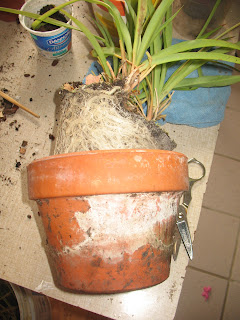 I had no idea the plant was so root bound. I knew there were at least three plants in the pot, but assumed they were doing okay. With that, I knew I had to split at least the two main clumps apart.
The first step was to make sure I had pots to put them into. My original thought was to simply clean the pot and put it back in the same one. I could still do this, but now had to have a second pot. I used a 1:9 ratio of bleach to water and cleaned the original. I scrubbed it with a wire brush and a toothbrush (retired from teeth work, of course!). After rinsing, the pot looked pretty good.

Although I really don't like cutting roots, it is one way to stimulate new growth and had to be done to get these plants apart. And this potted group of plants would probably have started to suffer, as a result of being so bound. After splitting, I potted the parts into to pots using fresh potting soil.
I also potted others, but still have some to do. As the winter progresses, I hope to work on my houseplants more and have them a bit happier when spring comes around. Of course, these winters can be rather long with cool temperatures, dry conditions and less-than-idea light, so this will be a major feat to accomplish! I hope this helps and good luck to all you working to achieve the same!
From what I understand, the most prolific pests on houseplants are mites and aphids. The first thing to do in looking for any pests is to visually inspect plants. In our area of southeast Minnesota, we had an early-season problem with earwigs - and they were everywhere! I was barely aware of this insect until this season. Fortunately, as the summer progressed, I noticed fewer of them around. And as I now inspect my potted plants, I have yet to see even one. In looking at my plants, I see some damage that was caused when I allowed some of my plants to dry out too much. Most plants look okay, except for my Christmas cactus. These plants have obvious signs of having been on the dinner buffet of some insect. I hope they left a good tip! Other than outright damage, some pests leave clues to their presence. The clues can include small spider-like webs, honey dew (sticky drops on plant surfaces), and blemishes to the plant foliage. And the scariest (to me) sign I found was when I was putting a hosta in the ground in September and found a webby mass in the bottom of the pot. Assuming these were spider eggs, I was happy to leave them outside.
Whatever the pest, I want to be sure to not host them in the house this winter. Also, I want to try to care for my houseplants better than I have done in the past. So, I first inspected the plants for signs that any pest was still in the plants that I brought in. I did see some mealybugs, as well as a few stray webs on another plant. But most looked pretty good. And these pests and signs can be easily removed by running water over the foliage or wiping with a cloth or sponge.
As I brought the plants indoors, I also realized that there were some that needed to be repotted. And this would help me to be sure there were no more of those hidden treasures, in the form of spider eggs, in the bottom of the pots! I also had a few geraniums that were still resting comfortably in the small plastic pots in which I had purchased them. So, there was work to do.
In repotting, it is important to understand when to do it. My theory is to not waste the resources, if it's not necessary. Here's a picture of a spider plant (Chlorophytum comosum) that had a few issues.

The pot was dirty and had a lot of salt deposits on it. So, I thought it best to clean it up. Then, when I took it out of the pot, here is what I found:

The first step was to make sure I had pots to put them into. My original thought was to simply clean the pot and put it back in the same one. I could still do this, but now had to have a second pot. I used a 1:9 ratio of bleach to water and cleaned the original. I scrubbed it with a wire brush and a toothbrush (retired from teeth work, of course!). After rinsing, the pot looked pretty good.

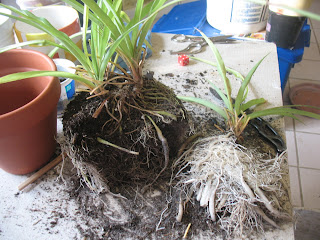
With that done and the second pot ready, I now had to split the plants.

Although I really don't like cutting roots, it is one way to stimulate new growth and had to be done to get these plants apart. And this potted group of plants would probably have started to suffer, as a result of being so bound. After splitting, I potted the parts into to pots using fresh potting soil.
I also potted others, but still have some to do. As the winter progresses, I hope to work on my houseplants more and have them a bit happier when spring comes around. Of course, these winters can be rather long with cool temperatures, dry conditions and less-than-idea light, so this will be a major feat to accomplish! I hope this helps and good luck to all you working to achieve the same!
Thursday, November 4, 2010
Planning for Next Year
During this fall, there is much to do regarding gardening, not to mention all the other activities we seem to be involved in. I had hoped to have more posts here and see that I need to be more disciplined about getting it done. Hmmm...that sounds a bit like my gardening, too! With that in mind, I am creating a Vegetable garden plan for next year while this and other lessons are fresh in my mind.
For the first time this year, I rented a garden space in Preston. A few people stated that that seemed like a long way to go for gardening. I thought it wouldn't be a big deal to travel the 16 miles to the east to tend a garden. I have to confess that it was an utter failure! I became too busy and the time slipped away. If anyone visited the Preston community garden, you only had to look for the plot that was total weeds - that was mine!
So, without dwelling on that negativity too much longer, I now know that YES, it was too far to go. I have a few other options for the additional garden space I was looking for last year. A friend of mine has offered space at her rental property - only 1/2 block from our home. And the space is great! It gently slopes to the west and has great sun exposure. I would need to till up or chemically remove the grass/weeds that have grown there in the past few years since someone last worked the soil. With my general avoidance of chemicals, I'd opt to borrow a tiller to get it ready.
But before I do that, I want to carefully consider my own backyard. I've been hesitant in the past to add much garden space because I like the area as a grassy place for the kids. And there's that convenience thing. The stakes are higher if I am at someone else's property - it must not look like a weed bed! So, will this be motivation or embarrassment? If the additional garden is in my backyard, there SHOULD be no extra excuses of distance and time.
While pondering the location, I need to think about what I've grown in the past few years. Of the vegetables I've grown, I need to consider the space they will require and future rotation to help minimize diseases. I will think about this and post again soon. My purpose of this discussion with myself is to assist others in planning or modifying a garden. As always, I hope this helps!
And I want to close with a quote that a fellow Master Gardener posted the other day. "The blood of our fallen heroes fertilized that dirt on your hands, to the keep the right to call it your own." Please always keep all of our U.S. military members in your thoughts and prayers. Be thankful for them, past and present, for they've sacrificed so much for our country.
For the first time this year, I rented a garden space in Preston. A few people stated that that seemed like a long way to go for gardening. I thought it wouldn't be a big deal to travel the 16 miles to the east to tend a garden. I have to confess that it was an utter failure! I became too busy and the time slipped away. If anyone visited the Preston community garden, you only had to look for the plot that was total weeds - that was mine!
So, without dwelling on that negativity too much longer, I now know that YES, it was too far to go. I have a few other options for the additional garden space I was looking for last year. A friend of mine has offered space at her rental property - only 1/2 block from our home. And the space is great! It gently slopes to the west and has great sun exposure. I would need to till up or chemically remove the grass/weeds that have grown there in the past few years since someone last worked the soil. With my general avoidance of chemicals, I'd opt to borrow a tiller to get it ready.
But before I do that, I want to carefully consider my own backyard. I've been hesitant in the past to add much garden space because I like the area as a grassy place for the kids. And there's that convenience thing. The stakes are higher if I am at someone else's property - it must not look like a weed bed! So, will this be motivation or embarrassment? If the additional garden is in my backyard, there SHOULD be no extra excuses of distance and time.
While pondering the location, I need to think about what I've grown in the past few years. Of the vegetables I've grown, I need to consider the space they will require and future rotation to help minimize diseases. I will think about this and post again soon. My purpose of this discussion with myself is to assist others in planning or modifying a garden. As always, I hope this helps!
And I want to close with a quote that a fellow Master Gardener posted the other day. "The blood of our fallen heroes fertilized that dirt on your hands, to the keep the right to call it your own." Please always keep all of our U.S. military members in your thoughts and prayers. Be thankful for them, past and present, for they've sacrificed so much for our country.
Wednesday, September 22, 2010
Master Gardener Recruitment
For anyone interested in becoming a master gardener, now is the time to think about it! The coordinator for Fillmore County just send out a notice regarding this. If you are interested, the first thing to do is to apply with your county coordinator. Once approved locally, you will be ready to go through the University of Minnesota's course online or at a class in Winona this spring. For further information, go to the University's master gardener website at www.mg.umn.edu. For any of you outside of Minnesota, most states have a master gardener program through an extension agency. If you live in Fillmore or Houston counties, you may also contact Jerrold Tessmer, Extension Educator, at tesme001@umn.edu.
Thursday, September 2, 2010
Cucumbers
What should we do with all these cucumbers? That is the million-dollar question for cucumbers and other veggies this time of year. I actually did not grow cucumbers this year, but have been gifted with a bunch! Some have been turned to pickles, but others have ended up in the compost bin, as they were ready to use at the time I acquired them, but I didn't have the time to process before they started to liquefy.
So, with these gifts, I tried my hand at pickling. I am a lover of dill pickles - home made or not. My mom sent to me a few pickle recipes, including a dill recipe from my Great Grandma Caldwell. I'm sure I have eaten her pickles in the past and was pretty excited to recreate them. The process seemed straight-forward and visual outcome was very nice!

The recipe said the pickles would be good to eat in two weeks and better as time progressed. I was excited to open my first jar last Sunday, but disappointed to taste how salty they were. Now, I don't mind salt and don't consider myself sensitive to it. My husband and mother-in-law also tested and concluded the same thing. The good news, though, was that my friend Deb said they went well with their bloody Marys! I think I'll have to head out to Sol N Tyne and check them out!
However, since tasting them, I have been considering the recipe and how to adjust it. The first part of the recipe was to soak the cucumbers in salt water. At first I thought that was the problem, but then realized that the extra pickles that I put in the 'fridge did not have the excessive salt flavor. So, the issue must be the brine. I think my next shot at this recipe will be to lessen the salt in the brine.
Tuesday, August 31, 2010
Systemic Repellant for Deer and Mice
Here is a link to a very interesting article about a new repellent for deer and mice to keep them away from plants. This was developed by a UMND scientist and is scheduled to be on the market in the Spring of 2011. Take a look at the article!
http://www1.umn.edu/news/news-releases/2010/UR_CONTENT_247932.html
http://www1.umn.edu/news/news-releases/2010/UR_CONTENT_247932.html
Subscribe to:
Posts (Atom)